

Hi,
Welcome to issue #33 of Odoo Trailblazer, our journey to become the #1 Odoo partner.
I’m writing to you from 40,000 feet above the Indian Ocean, flying from Singapore to Marseille. Singapore is the city of relentless innovation, and you now see AI advertised everywhere.
It reminds me of the blockchain hype a few years ago.
Yes, the AI revolution is very different, but to some extent, it is also the same.
TL;DR:
AI is a multiplier: It multiplies the quality of your data. If your data is bad, AI just helps you make bad decisions faster.
Don’t build software: Custom software is a liability. Adopt a standard platform (ERP) to build a solid foundation.
The 4 IT Revolutions: You cannot skip a step. You need Software, the Internet, and IoT (Real-time data) before you can use AI.
Why Odoo: It is the only platform that unifies all 4 layers without the technical debt of legacy giants.

I vividly remembered a meeting with a potential Asian client a few months back. It was with a director of a midmarket firm. All we could hear and read was “We need AI.”
Not speaking about specific problems they wanted AI to solve, their answer was the same: “We need AI.”
I’ve seen that many times in the past, when clients were asking for IoT or blockchain, but when you looked at their data, they were not yet able to know their inventory level or real COGS (cost of goods sold).
Often, they have a very advanced “in-house power engine”, but the reality is often dozens of disconnected systems and many spreadsheets.
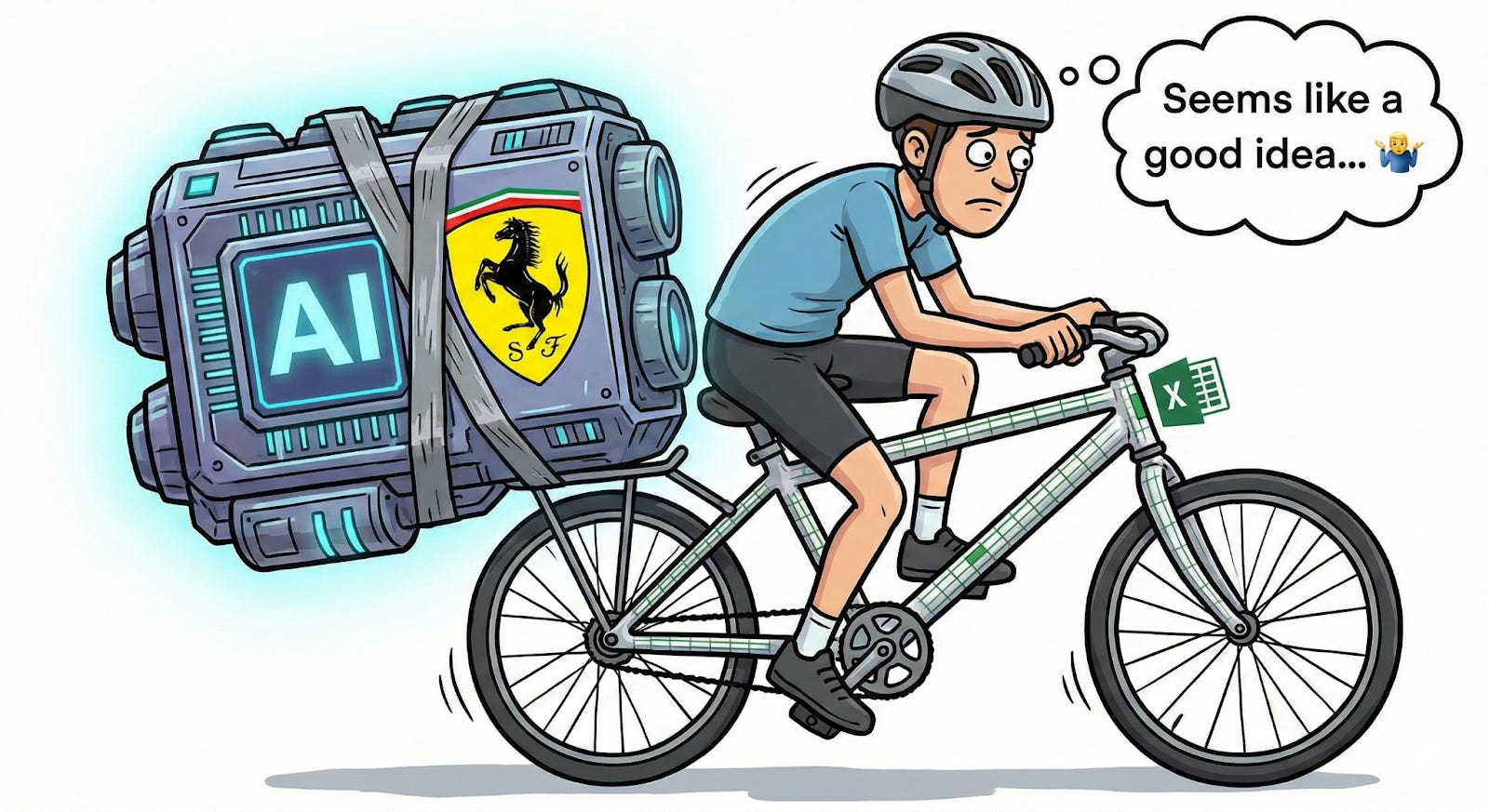
They want to run a Ferrari engine (AI) on a bicycle frame (Excel).
I’ve spent the last decade implementing software (essentially Odoo) for companies ranging from small startups to large enterprises. I’ve seen what works, and I’ve seen expensive disasters.
Today, I want to share my vision on the evolution of IT, why “building” your own software is a trap, and why you need a boring ERP strategy before you can have an exciting AI strategy.
Agenda
The 4 IT revolutions: How we got here.
The stacking effect: why benefits stack, but complexity stacks faster.
The hype distraction: why you are looking at the wrong thing.
Don’t build software: the “unique snowflake” syndrome.
The ERP strategy: your business needs a central brain.
Why Odoo: The foundation for the future.
1. The 4 IT revolutions
We didn’t get to the age of AI overnight. In my view, businesses have gone through four distinct revolutions.
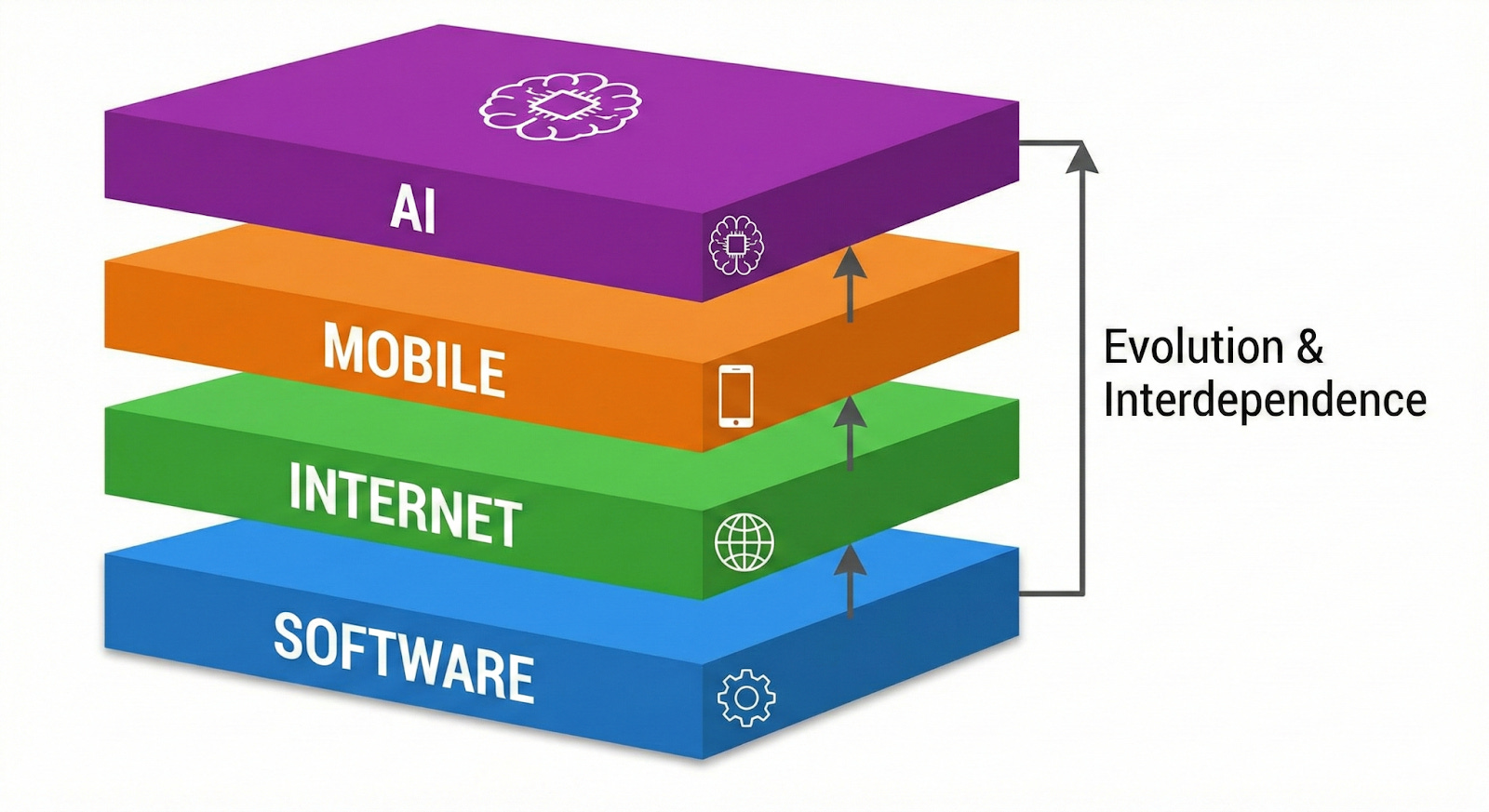
Most people treat these as a timeline, but they are actually layers of pressure.
Revolution 1: integrated software ( = data & automation). We moved from paper to digital. We could finally track data and automate basic calculations.
Revolution 2: the cloud and internet ( = connectivity). Suddenly, headquarters could talk to branches. Employees could email clients. Systems started to link up.
Revolution 3: mobile & IoT ( = the real world in real time). Software left the office and went to the factory floor, the delivery truck, and the warehouse worker’s pocket. We started capturing data at the source.
Revolution 4: AI ( = leverage). This is where we are now. AI leverages all that previous data to boost productivity exponentially.
2. The stacking effect
Here is the catch: these benefits stack up.
You cannot skip a step.
(Unless you’re trying to skip leg day, but that’s a different kind of technical debt.)

If you want the benefits of revolution 4 (AI), you need the foundation from the 3 previous phases: integrated software, connectivity, and mobile/IoT.
But here’s what most people miss: benefits stack, but complexity stacks faster.
Let’s look at a concrete example: modern retail.
I learned this while working with Alibaba in Mexico on an omnichannel project. Everyone thinks the bottleneck in e-commerce is the website or the “tech.”
It isn’t. The bottleneck is logistics.
To achieve a true “Omnichannel” experience (where a customer buys online, picks up in-store, and returns via courier), you need the first three revolutions working perfectly:
Software: your warehouse needs an ERP to know you have the item.
Internet: your e-commerce site needs to talk to that warehouse in real-time.
Mobile/IoT: the store clerk needs a handheld scanner to reserve that item the second the order comes in, before a walk-in customer buys it.
AI Layer: The AI noticed this shirt is selling fast in Singapore and automatically triggered a supplier order 3 days ago, so you wouldn’t stock out today.
The Point: If one layer fails (for example, if the scanner isn’t synced to the software in real-time), the AI makes the wrong decision. It re-orders stock you already have, or sells stock you don’t have. The customer is angry, and you lose money.
If any of these layers fail, the whole system breaks. And if you try to apply AI to predict inventory without that real-time data foundation, your AI is just guessing.
3. Business leaders are wrongly distracted by the hype
This is where I see leaders failing. They focus on the “hype” tech before getting the fundamentals right.
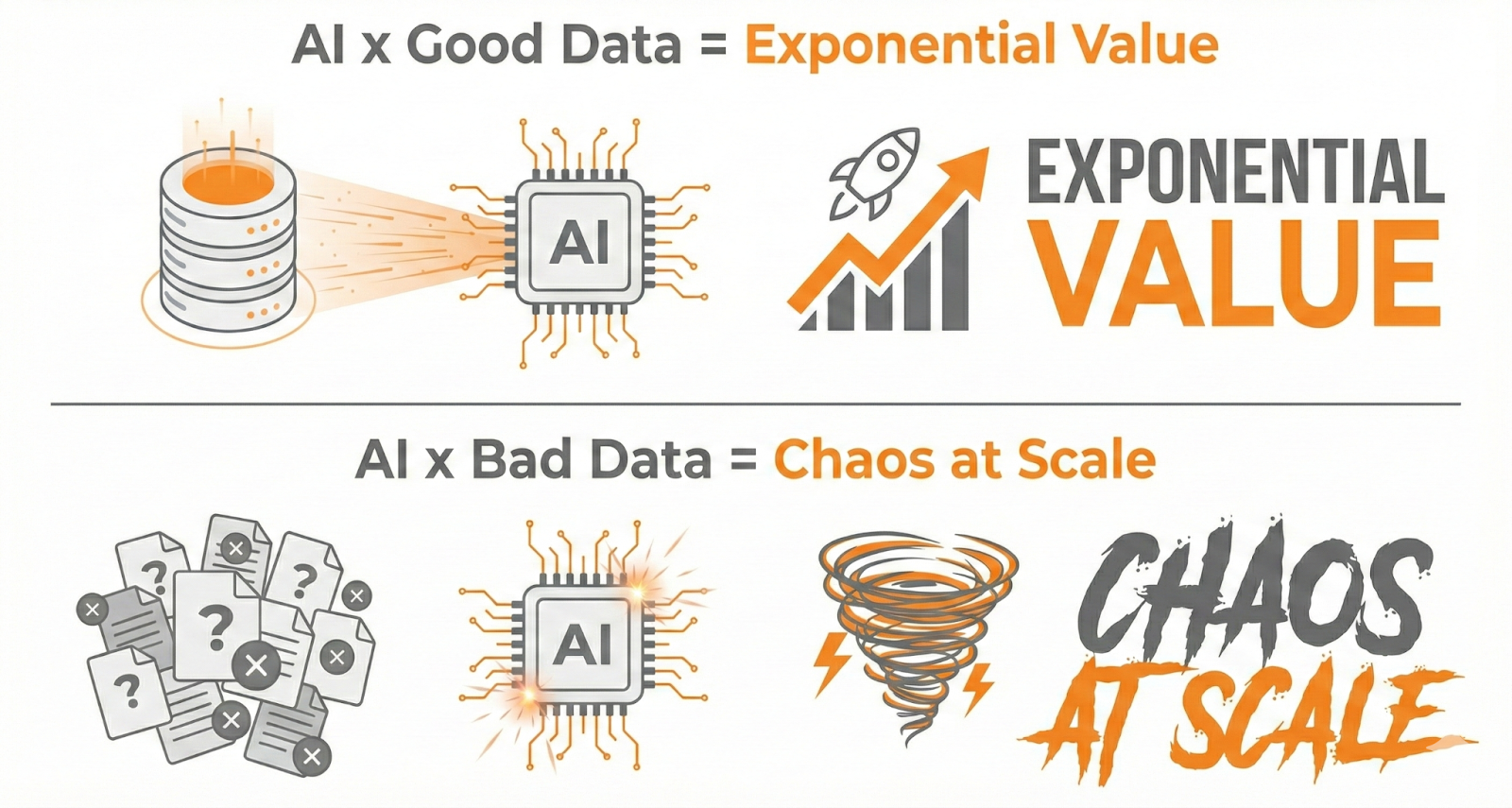
AI is a multiplier.
Years ago, everyone wanted Blockchain to “revolutionize their supply chain,” even though they were still managing inventory on Excel spreadsheets.
Now, everyone wants AI to “optimize their workforce,” but they don’t even have a centralized HR system to track who is working on what project.
I see it every week. Companies want ChatGPT wrappers and predictive forecasting, but their inventory data is 3 days old because “the systems only sync at night.”
If your data is bad, AI just helps you make bad decisions faster.
You need to refocus on the fundamentals. You must earn the right to use AI by fixing the foundation first.
4. Do not build software
I have to be humble here: we made this mistake, too.
In the past, even at Port Cities, we fell into the trap of over-customizing Odoo for our clients. Sometimes, we even tried to build tools in-house instead of reusing what already worked.
We thought we were special. We thought our needs were unique.
But I will say it again: stop trying to build your own software.
I see so many companies falling into the “Builder’s trap.” They almost always fail.

Don’t believe me? Ask Hertz. They paid Accenture $32 million to build a custom website and app. Two years later, they had zero usable code and a massive lawsuit on their hands. If a Fortune 500 company can’t build custom software successfully, neither can you.
Building software is incredibly complicated. Maintaining it is even harder. In the 2000s, building custom software was a competitive advantage. Today, it is a liability.
Bad Strategy: building your own CRM or Accounting system from scratch. (70% failure rate, high maintenance).
Good Strategy: Adopt a platform that covers 90% of the standard, and only “build” the 10% that is your specific secret sauce.
The Catchphrase: “Ownership is a liability. Agility is the asset.”
Every line of custom code you write is technical debt you must maintain. Winners today don’t build; they compose. They take a robust platform and configure it. They assume: ‘If my process doesn’t fit the standard software, maybe my process is the problem.’
Lidl, one of the biggest retailers in Europe, learned this the hard way. They spent €500 million trying to customize SAP to fit their ‘unique’ inventory valuation method. After 7 years of burning cash, they scrapped the whole project and went back to the standard. Do not be like Lidl.
5. You need an ERP strategy
If you don’t build software, you might be tempted to buy 50 different “best-in-breed” SaaS applications.
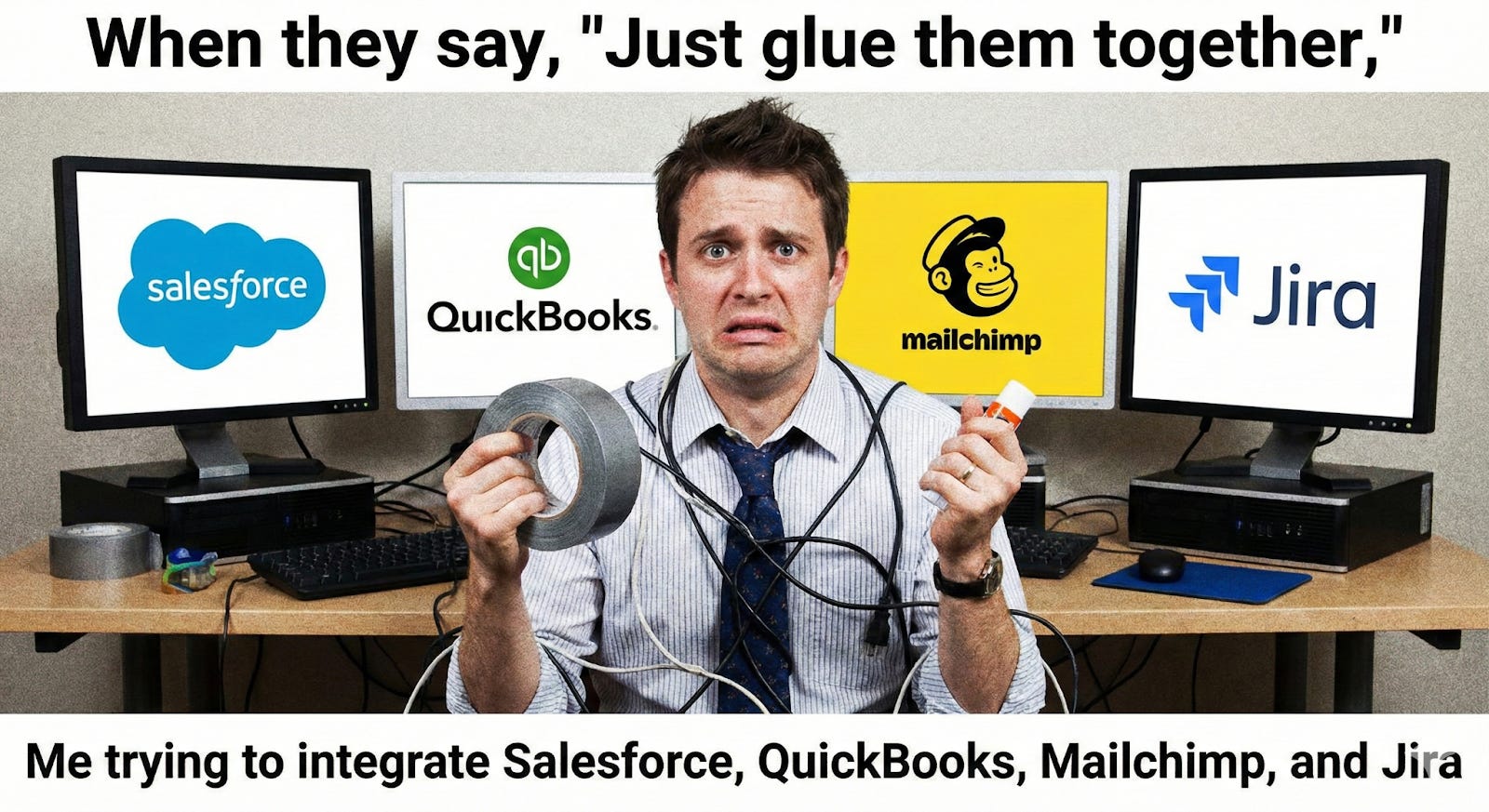
For the last 15 years, this was the dominant IT strategy. You bought Salesforce for sales, QuickBooks for finance, Mailchimp for marketing, and Jira for projects.
You are not alone in this mess.
In 2024, the average large enterprise is juggling 112 different SaaS applications.
Then you spent millions trying to glue them together.
The Cost: You spend more money connecting them than using them. Data acts like a liquid; every time you move it between pipes (software), you leak some.
You end up managing API connections, data syncing issues, and conflicting databases. You lose the “single source of truth.”
The Solution: an ERP strategy isn’t about buying one big tool; it’s about Data Unity.
You need a central nervous system for your company. You need one place where all your data lives, talks, and integrates. Without this, you cannot have real-time data. And without real-time data, you cannot have the AI revolution.
6. Why Odoo? The foundation for the future
We have looked at the market. We have implemented SAP, we have seen Oracle, and we have worked with custom stacks.
We have not found a better foundation than Odoo.
This is why we bet our career and our company on Odoo.
I am not saying this just because we sell it. I am saying it because Odoo is the only platform that scaled horizontally (covering all 4 revolutions: Web, Backend, Mobile, AI) without the technical debt of the giants like SAP or Oracle.
Why? Because Odoo understands the “Stacking Effect.”
It covers Revolution 1 (solid apps for every department).
It is web-based (Revolution 2).
It has native mobile apps and IoT boxes for the shop floor (Revolution 3).
And now, Odoo is integrating AI directly into the platform (Revolution 4).
It allows us to execute the strategy I just described:
Standardize your core.
Connect your workforce.
Clean your data.
Unlock the value of the 4th revolution (AI).
Odoo allows you to stop building and start integrating. It gives you the ERP strategy you need to actually leverage the hype, rather than just talking about it.
Conclusion
I know it’s not sexy to talk about ERPs in 2026. It’s much cooler to talk about Large Language Models (LLM) and autonomous agents.
But if you want to win in the next 10 years, you don’t need more hype. You need discipline.
The companies that win in the next decade won’t be the ones with the flashiest AI. They will be the ones with the cleanest data and the most unified platforms.
You need to stop building custom toys, consolidate your data, and build a boring, solid foundation. Once you do that, the AI revolution will be easy for you.
We are still learning how to perfect this for our clients, but the vision is clear.
What do you think? Are you still trying to glue “best-in-breed” apps together, or have you moved to a unified platform?
I’d love to hear your thoughts.
Best,
Gaspard
P.S. If you are struggling to fix your foundation, drop us a line. We’ve helped hundreds of companies stop building and start growing.
Follow us on LinkedIn for more updates: Gaspard (Founder & CEO), or Port Cities (our company page).